
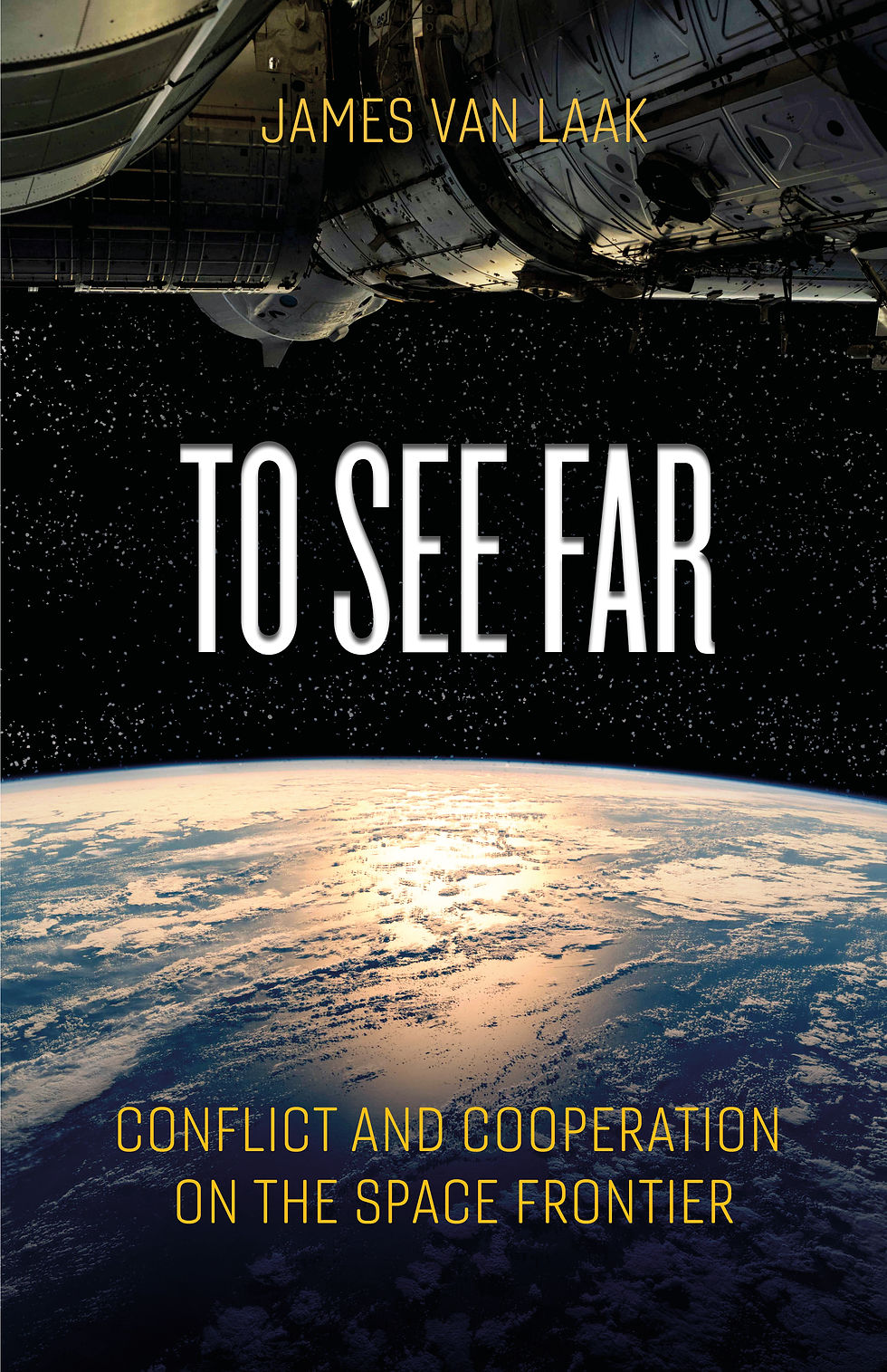
To See Far Conflict and Cooperation on the Space Frontier
A grounded account of how long-term perspective, trust, and cooperation emerged in one of the least likely places: Cold War rivals learning to work together in space.
We go into space to see far.
This book traces how spaceflight forced adversaries to confront shared risk, how long-range thinking can temper fear, mistrust, and partisanship, and why cooperation in extreme environments offers practical lessons for conflicts on Earth.
Narrative Overview
To See Far, Conflict and Cooperation on the Space Frontier is the foundation upon which this effort is built. Its honest account admits the frailty of its participants and demonstrates the ways in which they were overcome. Its product, the International Space Station, has been a literal and figurative guiding light to show us the future we want for our children. It crosses the night sky above nearly all of the human population on Earth, showing what can be done when people of good will decide to work together.
Cooperation Under Pressure
The most revealing tests of cooperation did not occur in conference rooms, but in orbit.
Crises aboard Russia’s Mir space station exposed both the fragility of the hardware and the limits of the partnership. Fire, power failures, and collisions were not abstractions. They were lived events that demanded clear thinking, disciplined communication, and an acceptance that no partner could solve the problems alone.
In this environment, trust was not a slogan. It was a daily practice built through shared procedures, agreed methods of reporting bad news, and a willingness to surface uncomfortable information early rather than late.
The operational discipline developed on Mir carried into the early construction and operation of the International Space Station. The habits of planning, cross-checking, and listening across cultural and institutional boundaries became part of how crews and ground teams managed risk together.
This book treats those episodes not as adventure stories, but as case studies in cooperation under extreme uncertainty.
Why the Book Matters Now
Although To See Far is rooted in the specific world of human spaceflight, its concerns are not confined to orbit.
The book offers lessons for people working in polarized environments who must still find ways to collaborate: in government agencies, universities, companies, and international organizations.
It speaks to leaders responsible for complex systems—technical, organizational, or social—where small decisions can have large and delayed consequences.
Rather than promising easy fixes, the book sketches a practical, sober, and human vision of cooperation: one that begins with clear-eyed acknowledgment of risk, conflicting incentives, and historical memory.
For readers who may never work in aerospace, To See Far offers a way to think about responsibility, trust, and time horizons in their own fields.
Part of a Larger Conversation
To See Far is one part of a broader body of work.
Jim Van Laak teaches, lectures, and consults on long-range thinking, safety, and cooperation in high-consequence settings. His public talks and outreach work aim to make questions of risk, responsibility, and trust accessible to wider audiences without simplifying them away.
The book is intended not as a final statement, but as a foundation for ongoing dialogue—with students, practitioners, and readers who are wrestling with how to act responsibly in complex systems.